Feed Cem TEZCAN [copy] https://yewtu.be/feed/channel/UCGcjzzEmGThh35eeDkvydeg has loading error: A feed could not be found at `https://yewtu.be/feed/channel/UCGcjzzEmGThh35eeDkvydeg`; the status code is `200` and content-type is `text/html`
Feed designboom magazine [copy] http://shalnoff.co.uk/rss.php?rss=designboom has loading error: cURL error 22: The requested URL returned error: 403 Forbidden
Feed formalista.ru [copy] http://feeds.feedburner.com/Formalista?format=xml has loading error: http://feeds.feedburner.com/Formalista?format=xml is invalid XML, likely due to invalid characters. XML error: > required at line 12, column 61
Feed Kinote.info [copy] http://kinote.info/sections/blog/articles.xml has loading error: https://kinote.info/sections/blog/articles.xml is invalid XML, likely due to invalid characters. XML error: Invalid document end at line 1031, column 7
Japanese Movie Poster: Kingdom of Dreams and Madness. Chie...

Japanese Movie Poster: Kingdom of Dreams and Madness. Chie Morimoto, Hayao Miyazaki, Nicolas Guérin. 2013
Japanese Advertising: oltana - Skin Meditation. Masayoshi...

Japanese Advertising: oltana - Skin Meditation. Masayoshi Kodaira. 2016
Japanese Album Cover: The Players - Galaxy. Eiko Ishioka, Motoko...
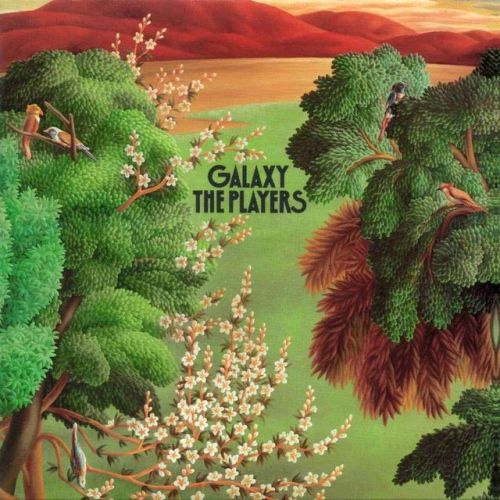
Japanese Album Cover: The Players - Galaxy. Eiko Ishioka, Motoko Naruse, Tamie Okuyama. 1979
Japanese Concert Poster: Neighborhood and the Surrounding....

Japanese Concert Poster: Neighborhood and the Surrounding. Daisuke Maeda, Contsu Toda (T.CONTSU). 2015
Masha Krasnova-Shabaeva
Procedural Bestiary and the Next Generation of CG Software
https://player.vimeo.com/video/703402772

In the previous essay “Procedural content creation F.A.Q.” I’ve claimed that it would take few months to assemble a full-scale creature generator. So I took those months and did it – introducing Kozinarium v1.0 v1.5:
Procedural Creature Generator from Denis Kozlov on Vimeo.
Procedural systems I’ve been developing during the recent years served different purposes, not the least one being exploration of how far one can go in formalizing the visual art, expressing its language in machine-readable terms. “Quite far” is the answer I’ve got, and today I’d like to share my vision of the next generation of artistic tools which could...
Procedural Content Creation F.A.Q. - Project Aero, Houdini and Beyond
https://player.vimeo.com/video/211742962

I’ve finally found the time to put together a long-requested video demo for Project Aero and would like to use this opportunity and answer some of the questions I’m often hearing in its regard.
Procedural Aircraft Design Demo from Denis Kozlov on Vimeo.
What is Project Aero?
Project Aero is the software I’ve developed for rapid design of aircraft concepts. The video above demonstrates its main features.
What does “procedural” mean?
In a wider
sense it means “automated” - created algorithmically by a computer
(rather than manually by a human operator or sampled like a scan or a
photograph). Here are the good places...
Tiles
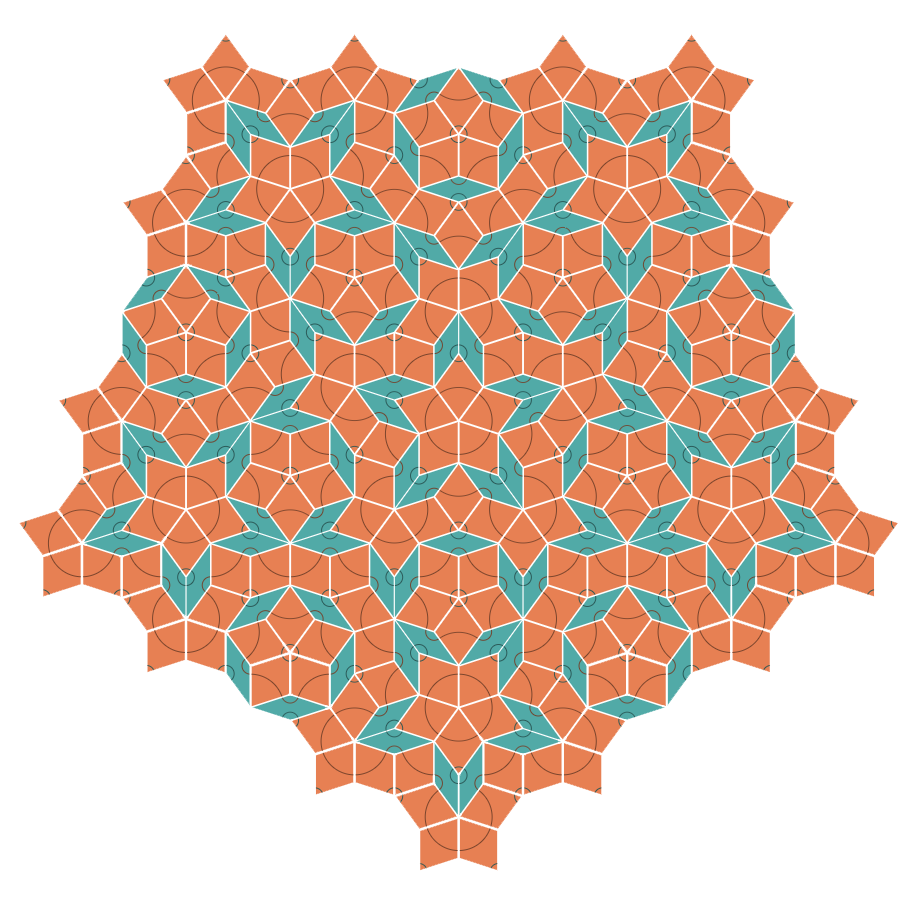
I have a new geometry toy, Tiles. It’s a thing that lets you play with aperiodic tilings, which are special tiles resist tessellating in a way that repeats itself.
You can swap between using kite and dart, and rhombus tiles, which are both kinds of penrose tilings.
I made it just because I wanted to play with these tiles. Originally I was looking for a way to try them out physically, by printing some and cutting them out, but eventually decided that it might be more fun to make it something I could share with other people.
Most my projects start out with...
Castles Made of Castles

Today I’m releasing Castles Made of Castles – a building tool where the pieces are the same as the whole.
Castles Made of Castles was commissioned by, and first playable at, the Now Play This festival in London. Game events offering commissions or exhibitor fees are rare, so I’m really grateful for the opportunity. Since the festival it’s been waiting around for me to tie up a few loose ends, and now that Push Me Pull You is finished, I’ve found the focus to give it a proper release.
Castles mixes fractals and voxels. Like most of my work on this site,...
Push Me Pull You
https://invidious.privacyredirect.com/watch?v=yeHD03_0C_A
Hi sciencevsmagic.net, sorry I haven’t updated my website for three years. I was making a videogame.
After you last heard from me, back in 2013, I got together with three friends and we decided to make a small videogame. We didn’t expect much. Mainly it sounded like a good excuse to hang out a bunch.
We had no formal experience in game development, or connections in the industry, but we had all been playing local-multiplayer games together and wanted to try making one for ourselves. After making Let’s Play: Ancient Greek Geometry I figured I probably knew *just* enough about programming that...