Feed Crystalfontz [copy] https://www.crystalfontz.com/blog/feed/ has loading error: cURL error 22: The requested URL returned error: 403
Feed linux for devices [copy] http://www.linuxfordevices.com/rss-feeds-1.xml has loading error: cURL error 22: The requested URL returned error: 404
Feed marsohod.org [copy] https://marsohod.org/component/ninjarsssyndicator/?feed_id=1&format=raw has loading error: cURL error 22: The requested URL returned error: 500
Feed SparkFun Electronics [copy] http://www.sparkfun.com/feeds/news has loading error: cURL error 22: The requested URL returned error: 405
Feed Technoblogy [copy] http://www.technoblogy.com/rss?KVM+3 has loading error: cURL error 22: The requested URL returned error: 503 Service Unavailable
Critical Link MitySOM-AM62x/A/P – TI Sitara AM62 SO-DIMM SoMs for edge AI and industrial automation

Critical Link MitySOM-AM62x/A/P is a family of TI Sitara AM62-based industrial SO-DIMM SoMs designed for embedded Linux systems, industrial automation, HMI, and other embedded applications. The family includes the general-purpose MitySOM-AM62, AI-focused MitySOM-AM62A, and multimedia-oriented MitySOM-AM62P system-on-modules. The standard AM62 modules feature up to a quad-core Arm Cortex-A53 processor at 1.4 GHz, along with a 400 MHz Cortex-M4F MCU and dual programmable real-time units (PRUs). The AM62A adds a C7x DSP with Matrix Multiply Accelerator supporting up to 2 TOPS and an image signal processor (ISP), while the AM62P includes a 3D GPU rated above 50 GFLOPS and a four-lane...
Up2Stream spins off from Arylic as a dedicated DIY audio brand (Sponsored)

Up2Stream started as Arylic’s DIY audio board line and has now been spun off as its own brand. The split is not a rebadge or a clone of Arylic’s finished consumer streamers and amplifiers. It is a deliberate move to put the maker community first: boards, accessories, documentation, and support aimed at people who build speakers, restore vintage gear, or design custom multiroom systems. Many long-time users still treat “Up2Stream” and “Arylic” as the same storefront. Others assume the boards are a copy of Arylic’s boxed products. They are related in history, but they serve different jobs. Arylic’s consumer line...
LILYGO T-Dongle-C5 – An ESP32-C5 USB dongle with microSD card slot, optional 0.96-inch OLED

LILYGO T-Dongle-C5 is an ESP32-C5 dual-band WiFi 6, BLE, and 802.15.4 USB dongle that builds upon the earlier ESP32-S3-based T-Dongle-S3 board. The new board still features an optional 0.96-inch color display, a microSD card slot, and a USB-A male port. The main differences are support for dual-band WiFi 6, 16MB flash, 8MB PSRAM, and the addition of a Qwiic expansion connector. T-Dongle-C5 specifications: Wireless SoC – Espressif Systems ESP32-C5HR8 CPU Single-core 32-bit RISC-V processor @ up to 240 MHz Low-power RISC-V core @ 40 MHz acting as the main processor for power-sensitive applications Memory – 384 KB SRAM on-chip, 8MB PSRAM...
Reverse-engineering the vintage Intel 8087's tangent algorithm: more than CORDIC
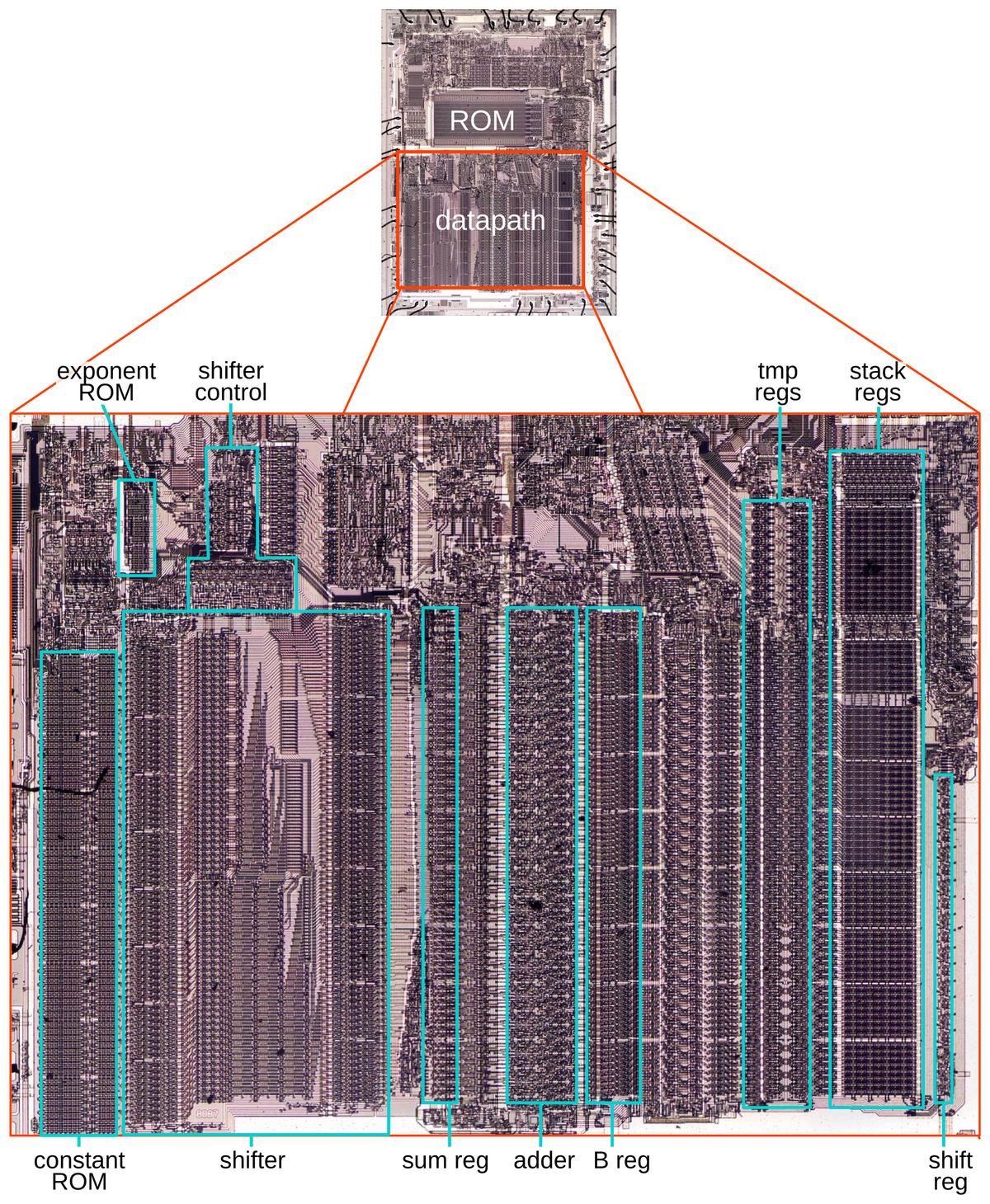
I hope you're not tired of the 8087, because I have another article about Intel's floating-point chip.1 In 1980, Intel introduced the 8087, making floating-point operations much faster in the IBM PC and other systems. In this article, I look at the algorithm behind the chip's tangent instruction. One popular approach for trigonometric functions is an algorithm called CORDIC. Another approach is a polynomial approximation. The 8087 combined the two to obtain both high accuracy and high performance. The 8087 provided an enormous speedup over the 8086 microprocessor, computing a tangent in 90 microseconds rather than 13,000 microseconds.2
By examining the circuitry and microcode of the 8087, I can explain the...
KryonOS turns ESP32 boards into JavaScript-powered mini computer

KryonOS is a small JavaScript-powered OS that turns a supported ESP32 development board with a touchscreen into a standalone computer with its own graphical interface, application launcher, and file storage. It provides the basic software environment needed to use the board without writing and flashing a separate firmware program for every application. Unlike traditional ESP32 firmware, KryonOS keeps applications separate from the main system and runs them through its built-in JavaScript runtime. It also includes an App Store that allows users to download and install applications and updates over Wi-Fi without reflashing the device. KryonOS key features: Supported MCUs –...
I'm starting HomelabFest (in St. Louis, Sep 2027)

I've been working on my homelab for years, and I enjoy sharing what I learn through this blog and my YouTube channel.
Over the past few years, I realized the homelab community (which isn't really a defined thing—that's okay) hasn't had its own gathering, the way makers, software engineers, embedded developers, and HPC professionals do.
There are many events that have crossover into the homelab realm, but nothing focused on energy-efficient servers, privacy-respecting self-hosted software, keeping old hardware useful, or cable management and rackmounting on a budget.
Compact Long-Wave Infrared camera pairs STM32N6 MCU with Lynred ATI320 thermal sensor

8devices 8Sight T100 is a compact Long-Wave Infrared (thermal imaging) camera for UAS, robotics, and industrial applications. It combines a Lynred ATI320 LWIR sensor with an STM32N6 Arm Cortex-M55 microcontroller featuring a Neural-ART NPU and a hardware ISP for edge AI inference and real-time thermal image processing. The camera delivers 320×240 thermal video at 60 fps and operates completely offline, allowing you to deploy custom AI models for object detection, anomaly detection, or temperature-triggered events without relying on cloud resources. 8devices 8Sight T100 specifications: MCU – STMicro STM32N657X0H3Q with an Arm Cortex-M55 core up to 800MHz with a 600 GOPS...
Lua-скрипты для тестера микросхем

Утилита ctc для тестера микросхем поддерживает написание тестов на языке Lua. Интерпретатор Lua встроен не в сам тестер, а в утилиту ctc — то есть скрипт выполняется на компьютере, а тестер используется как интерфейс ввода-вывода.
Это позволяет писать собственные тесты для микросхем, которых нет в стандартной базе, или отлаживать сложные сценарии проверки (например, для БИС вроде 8251, 8259, Z80 и т.д.).
Быстрый стартПростейший скрипт:
setChipSize(28)

bus('D', 27, 28, 1, 2, 5, 6, 7, 8)

pin('CLK', 20)
pin('~RESET', 21)

configOutput('CLK', '~RESET')
configInput('D')

enablePower(-4, 26)

set('~RESET')
pulseDown('CLK')
clr('~RESET')
Этот скрипт:
Задаёт размер микросхемы (28 выводов). Объявляет шину данных D из...Как городской телефон определяет номер? Запускаем Caller ID в домашних условиях

Приветствую всех!
Если у вас дома есть городской телефон и он показывает, с какого номера вам звонят, то, скорее всего, это определение работает через Caller ID. Когда-то давно эта технология подчистую заменила «традиционный» для нашей страны АОН, а там, где стационарные телефоны ещё остались, используется до сих пор.
Как же всё это работает, и можно ли запустить такое у себя? Сейчас и узнаем...
Press F1 to continueРадио почти из ничего. Самодельные радиодетали 1920-х. Аккумуляторы

На заре радио, когда ещё не существовало налаженного промышленного производства компонентов, необходимых для самостоятельной сборки приборов, либо такие элементы были дефицитны и дороги — любителям того же радио приходилось собственноручно и из подножных материалов изготовлять почти всё нужное — не только коробку (шасси) прибора, антенну с заземлением, но и, например, резисторы [1], конденсаторы [2], детекторы [3] для первых детекторных радиоприёмников. Появление катодных ламп позволило конструировать приёмники с усилением по низкой и высокой частоте, чтобы принимать не только мощную местную станцию, но заглянуть в радиоэфир дальше и слышать передачу лучше. Здесь, однако, кроме прочего, вставал вопрос питания радиоламп — в отсутствие осветительной сети, нужно...