Feed Crystalfontz [copy] https://www.crystalfontz.com/blog/feed/ has loading error: cURL error 22: The requested URL returned error: 403
Feed linux for devices [copy] http://www.linuxfordevices.com/rss-feeds-1.xml has loading error: cURL error 22: The requested URL returned error: 404
Feed marsohod.org [copy] https://marsohod.org/component/ninjarsssyndicator/?feed_id=1&format=raw has loading error: cURL error 22: The requested URL returned error: 500
Feed scanlime.org [copy] http://scanlime.org/feed/ has loading error: A feed could not be found at `http://scanlime.org/feed/`; the status code is `200` and content-type is `text/html`
Feed SparkFun Electronics [copy] http://www.sparkfun.com/feeds/news has loading error: cURL error 22: The requested URL returned error: 405
Feed Technoblogy [copy] http://www.technoblogy.com/rss?KVM+3 has loading error: cURL error 22: The requested URL returned error: 503 Service Unavailable
(Updated) ESP-Mosaico centers dual-core RISC-V ESP32-S31 around a 2.16-inch square AMOLED
The Espressif ESP-Mosaico is an expandable smart-interaction development kit based on the ESP32-S31 microcontroller. The compact device integrates a 2.16-inch square touch display, audio hardware, motion and magnetic sensors, NAND storage, haptic feedback and dual expansion interfaces for HMI, edge voice and multimedia applications. The ESP32-S31NRV16 at the center of the board provides two 32-bit […]
Picotronix modular oscilloscope and logic analyzer features two Raspberry Pi Pico 2 boards (Crowdfunding)

Picotronix is a modular oscilloscope, logic analyzer, and frequency meter from Sydney-based Thort Werx Pty Ltd, based on two Raspberry Pi Pico 2 units, more exactly a Pico 2 used as a signal processor and a Pico 2 W used to drive the display and for wireless connectivity. The solution is comprised of the Picotronix Main Module with an integrated LCD and three expansion ports, used to connect picoPods plug-in expansion modules to add high-speed ADCs, mixed-logic family logic state analysis, a waveform generator, analog conditioning, and more. Picotronix key features and specifications: Main Module Two-channel digital storage oscilloscope 8-channel...
Noctua Fan Swap on a Calnex Rb/GPS Frequency Reference

Since this will be the only source of this process on the Internet1, I figured I'd document a quick fan swap I did on a piece of test/reference equipment I'm running in my Atomic Clock Tower.
I took my Torx T10 screwdriver and popped off the top cover. The screws required some force to loosen, as they were all secured with Loctite.
The inside is simple and serviceable. There's a SpectraTime GRClok-1500, with an integrated timing-grade GPS module, and a stabilized 10 MHz output2.
Synergy Logic SLM-RP4 – A Raspberry Pi 4 PLC with modular industrial I/Os

Synergy Logic SLM-RP4 industrial PLC is built around a Raspberry Pi 4 SBC and designed for industrial automation, machine control, data acquisition, and Industrial IoT (IIoT) applications. The DIN-rail mountable controller supports 24V DC input and an SPI-based backplane that connects up to eight Synergy Logic I/O modules, providing up to 128 I/O points. It also features Gigabit Ethernet, WiFi 5, Bluetooth 5.0, USB ports, two micro-HDMI outputs, and a fanless aluminum enclosure. The system runs Raspberry Pi OS with OpenPLC pre-installed for standard IEC 61131-3 logic programming. Synergy Logic SLM-RP4 specifications: SBC – Raspberry Pi 4 Model B (2GB...
Rockchip RK3576-powered SMARC 2.2 system-on-module and development board target Edge AI applications

MYIR MYC-JR3576 is a SMARC 2.2 system-on-module (SoM) powered by a Rockchip RK3576/RK3576J octa-core Cortex-A72/A53 SoC with a 6 TOPS NPU designed for Edge AI applications. It features up to 8GB LPDDR5, up to 64GB eMMC flash, an optional WiFI 6E and Bluetooth 5.4 module, and exposes all I/Os through a 314-pin MXM connector as defined in the SMARC 2.2 standard. The company says it’s the socketed counterpart to its LGA-packaged MYC-LR3576 (43 x 45 mm) module introduced in 2024, so the same processor is now available in both solder-down and standard form factors from MYiR. MYC-JR3576 – Rockchip RK3576...
ESP32-C6-DevKit-Lipo becomes a Matter light: a step-by-step guide

Matter is the smart-home standard that Apple Home, Google Home, Amazon Alexa and SmartThings all speak. It lets one device work across platforms without being locked into a single vendor’s ecosystem. We wanted to show how easy it is to start developing Matter devices on open source hardware, so we wrote a complete, tested guide […]
 olimex
Adafruit Metro ESP32-P4 Hydra – An Arduino UNO-shaped ESP32-P4 + ESP32-C6 board with WiFi 6, MIPI interfaces

Adafruit has launched the Metro ESP32-P4 Hydra, an Arduino UNO-shaped development board with ESP32-P4, 16MB PSRAM, and 16MB NOR flash, and an ESP32-C6 for WiFi 6, Bluetooth 5.3 LE, Thread, and Zigbee connectivity. Other features include Raspberry Pi-compatible MIPI DSI and CSI interfaces, a USB 2.0 High-Speed host port, a microSD card slot, and Arduino UNO expansion headers. The board also includes a STEMMA QT connector, LiPo battery charging, and multiple power input options, making it suitable for HMI, camera, and IoT applications. Adafruit Metro ESP32-P4 Hydra specifications: Microcontroller – Espressif Systems ESP32-P4 (v1 chipset) CPU Dual-core 32-bit RISC-V HP (High-performance)...
Name that Ware, October 2026
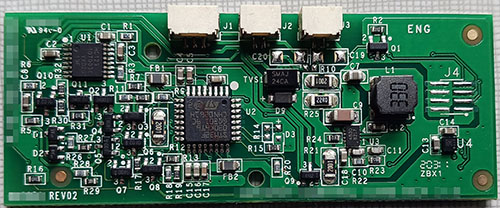
The Ware for October 2026 is shown below:
Another contribution from FETguy and Renew Computers! I found this board to be interesting mainly because I always wondered how these things worked. The construction reveals a trick which ended up as a surprise, at least to me!
A couple of administrative notes – I am counting my blessings that this site is still up despite the heightened level of CVE’s. This is an aging WordPress blog (its origins pre-date “the cloud” and HTML5!), which uses PHP at its core, and kudos to Pair Networks for being on top of it...
Winner, Name that Ware September 2026
The Ware for September 2026 is a tire pressure monitor from a late 80’s to early 90’s model Porsche, made by Bosch. According to the submitter:
Apparently they were deeply unpopular since the sensor mechanism used transponders fitted into pockets in special wheels, which meant lots of alarms when owners changed to wheels without the transponders. Each wheel’s suspension mounted an antenna operating at a “high frequency” of probably a few MHz. When a tire’s pressure dropped below a threshold, a pressure switch in the transponder would open or close, which would change the signal sent back, and this...
The museum I volunteer at has been seized by the NSW government and they intend to destroy it

Museum collections in peril, volunteers fearful, charity fighting to get the ship and its contents back.