Feed Crystalfontz [copy] https://www.crystalfontz.com/blog/feed/ has loading error: cURL error 22: The requested URL returned error: 403
Feed linux for devices [copy] http://www.linuxfordevices.com/rss-feeds-1.xml has loading error: cURL error 22: The requested URL returned error: 404
Feed marsohod.org [copy] https://marsohod.org/component/ninjarsssyndicator/?feed_id=1&format=raw has loading error: cURL error 22: The requested URL returned error: 500
Feed SparkFun Electronics [copy] http://www.sparkfun.com/feeds/news has loading error: cURL error 22: The requested URL returned error: 405
Feed Technoblogy [copy] http://www.technoblogy.com/rss?KVM+3 has loading error: cURL error 22: The requested URL returned error: 503 Service Unavailable
Four-port IO-Link module for Raspberry Pi and embedded Linux systems
Pinetek Networks has developed the IOL Core4, a compact IO-Link-compatible master module for embedded systems. It connects up to four industrial sensors or actuators over IEC 61131-9 SDCI and is intended for integration into custom control, monitoring and IIoT hardware. The module uses two Analog Devices MAX14819 dual IO-Link master transceivers. The standard PT-1204 version […]
Avaota F2 – Allwinner V861 RISC-V SBC targets AI cameras with PTZ and audio support

Avaota F2 is the first SBC based on an Allwinner V861 dual-core 64-bit RISC-V SoC with 128MB on-chip DDR3 memory, support for 4K cameras, H.265 video codec, and a 1 TOPS AI accelerator. It’s an update to the earlier Avaota F1 camera board based on an Allwinner V821 SoC. The new open-source hardware F2 SBC offers several benefits, including support for both Full HD and 4K camera sensors, motor control for the PTZ (Pan-Tilt-Zoom) feature, and improved audio support through speaker (one) and microphone (two) connectors. However, the F1 also included WiFi, which the Avaota F2 lacks. Avaota F2 specifications:...
ASRock Industrial NUC 300 series – Intel Core 3 304/Core 5 320 mini PCs and motherboards

ASRock Industrial has introduced the NUC Core 300 BOX series of mini PCs and the NUC Core 300 motherboards built around Intel Core Series 3 Wildcat Lake-U processors. The lineup includes the NUC BOX-320, with the Intel Core 5 320 SoC, and the NUC BOX-304, which uses the Core 3 304 SoC. The company also offers the NUC-320 and NUC-304 as standalone motherboards for custom systems. The systems support up to 64GB DDR5-6400 with In-Band ECC, dual M.2 PCIe Gen4 storage, dual 2.5GbE, Wi-Fi 6E, Bluetooth 5.3, triple-display output, USB 3.2 connectivity, and 12–24V DC input. These features make them...
LakeShark firmware turns LilyGO T-Display P4 into a handheld ESP32-P4 SDR scanner

LakeShark is open-source firmware by Samuel Reynolds (SAMS0N1TE) that turns the ESP32-P4-based LilyGO T-Display P4 into a handheld SDR scanner. Paired with an RTL-SDR Blog V3 or V4 dongle, it supports P25 Phase I trunking, analog FM/AM, POCSAG pager decoding, and 1090 MHz ADS-B reception directly on the ESP32-P4, without a PC, Raspberry Pi, or smartphone. It also includes an onboard SX1262 that supports LoRa and MeshCore applications. SDR devices like LimeSDR Micro, xSDR, UUGear’s VU GPSDR, and many others usually rely on a PC, Raspberry Pi, or smartphone for processing, but LakeShark shows that a powerful microcontroller can also handle...
A733 development board with LPDDR5, PCIe storage and RISC-V coprocessor
Shenzhen Graperain Technology has featured an Allwinner A733 development platform with a gold-finger system-on-module and carrier board. It provides an octa-core Arm processor, 3-TOPS NPU, LPDDR5 memory, M.2 storage, GbE and multiple display and camera interfaces. The Allwinner A733 integrates two Cortex-A76 cores and six Cortex-A55 cores, with Graperain specifying a maximum CPU frequency of […]
$30 Raspberry Pi Smart Display Module for CM5 targets digital signage displays and kiosks

Raspberry Pi Smart Display Module is a CM5 carrier board compatible with the Intel Smart Display Module (SDM) specification, more specifically the SDM-L form factor (as opposed to the smaller SDM-S option). The Intel SDM standard has been around for years, and we first wrote it in 2018, covering the Axiomtek SDM300s (SDM-S) module. These cards are designed to be plugged into compatible digital signage displays, kiosks, point-of-sale systems, and so on. They feature a standard 98-pin PCIe edge connector with USB 3.0, HDMI 1.4/2.0, I2C/UART/SPI signalling, as well as Ethernet, HDMI, USB ports, and an M.2 expansion socket. Raspberry Pi...
OpenArm 2.0 – An open-source 7-DOF robot arm with QDD joints, bilateral force feedback, in-hand camera

Tokyo-based Enactic OpenArm 2.0 is an open-source hardware 7-DOF robot arm designed for physical AI research, teleoperation, and contact-rich data collection. It uses quasi-direct-drive (QDD) backdrivable joints to support compliant motion and bilateral force-feedback control. The arm supports 4.1 kg nominal and 6 kg peak payload, features 1 kHz CAN-FD control, and a compact parallel gripper with an in-hand camera and replaceable fingers. It supports bilateral force-feedback teleoperation, gravity compensation, and compliant interaction, with an aluminum and stainless-steel structure and MISUMI-frame base. The ecosystem also includes the OpenArm Cell for standardized evaluation and OpenArm KER, a motorless replica for teleoperation...
ESP32-C5 devkit features 3.5-inch touch LCD, optional camera and battery

Waveshare ESP32-C5-Touch-LCD-3.5 is another ESP32-C5 devkit with a built-in display, but equipped with a larger 3.5-inch color touch LCD and an optional BF3901 low-resolution (0.08 MP) camera and/or a 500 mAh battery. It also features a speaker connector and a built-in microphone for voice interaction, a 6-axis IMU and a temperature and humidity sensor, a microSD card slot for additional storage, and a 32-pin GPIO connector for expansion. ESP32-C5-Touch-LCD-3.5 specifications: Wireless module – Espressif Systems ESP32-C5-WROOM-1U-N32R8 SoC – ESP32-C5HR8 CPU Single-core 32-bit RISC-V processor @ up to 240 MHz Low-power RISC-V core @ 40 MHz acting as the main processor...
Name that Ware, September 2026
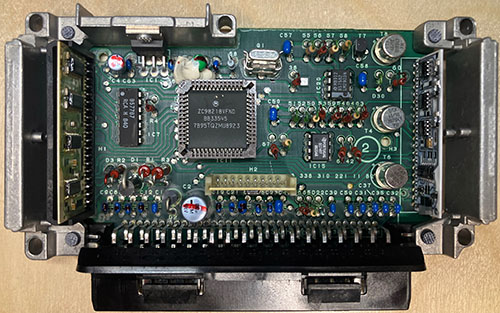
The Ware for September 2026 is shown below.
We seem to be on a theme of hybrid circuits! This aesthetically pleasing ware was submitted anonymously. Thank you, you know who you are!
While I realize that color palettes are not actually a deciding factor in most circuit board designs, I still appreciate it when things work out to have a nice color scheme overall. I like how the bold colors of the main circuit board draw contrast with the pastel earth-tones of the hybrid circuits.
Winner, Name that Ware August 2026
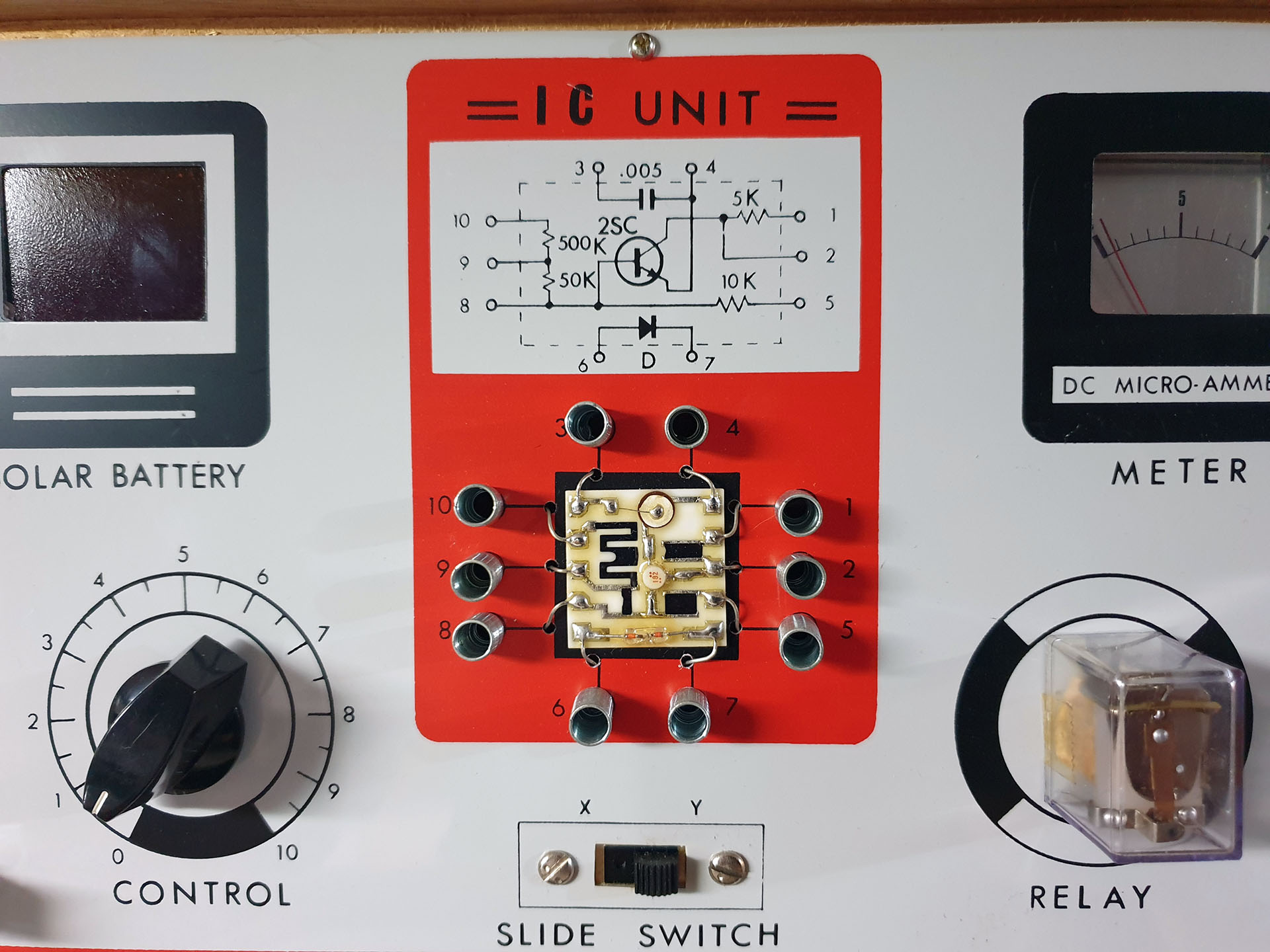
The Ware for August 2026 is the “IC unit” from a Lafayette 150-in-1 “IC Electronic Project Kit”, part number 99-35107.
Above is a contextual photo of how the unit looked mounted in the kit.
And above are a couple examples of projects you can build with the “IC” as part of the kit.
Answering Hales’ question, the part itself is covered with a clear overcoat of polymer that looks liquidy, but it is in fact a durable, hard coating. As a child, I appreciated how almost every part was out there and easy to see – you can really...